
Division of Environmental Quality Director: Art Goodin
This fact sheet is intended to provide guidance to the agricultural anhydrous ammonia regulated community regarding anhydrous ammonia storage vessels with missing or illegible data plates. It is not intended to enact policy for the Missouri Department of Natural Resources, nor does it serve as a way for determining compliance with state or federal regulatory requirements. There is no need to discard a storage vessel if any of the options discussed below apply.
The Compressed Gas Association Standard CGA G-2.1-2023 – Requirements for the Storage and Handling of Anhydrous Ammonia–7th Edition states that anhydrous ammonia storage vessels with missing or illegible data plates must be removed from service by Jan. 1, 2030, unless a replacement data plate is able to be issued or the storage vessel is inspected. The storage vessel may continue service beyond 2030 if any of the following criteria are met:
- A replacement data plate may be issued if the original manufacturer is still in business, and the storage vessel owner can provide a form U-1 or U-1a data report and verify the storage vessel in question is the original storage vessel that is claimed; or
- A replacement data plate may be issued if the manufacturer is no longer in business, the storage vessel owner can provide the department with a form U-1 or U-1a data report and verify the storage vessel in question is the original storage vessel that is claimed; or
- The storage vessel undergoes an inspection to verify the information below:
- Wall thickness of the container shell and heads in inches or millimeters.
- Water capacity of the container in pounds, kilograms, gallons or cubic meters at 60 degrees Fahrenheit.
- Outside surface area of the container in square feet or square meters.
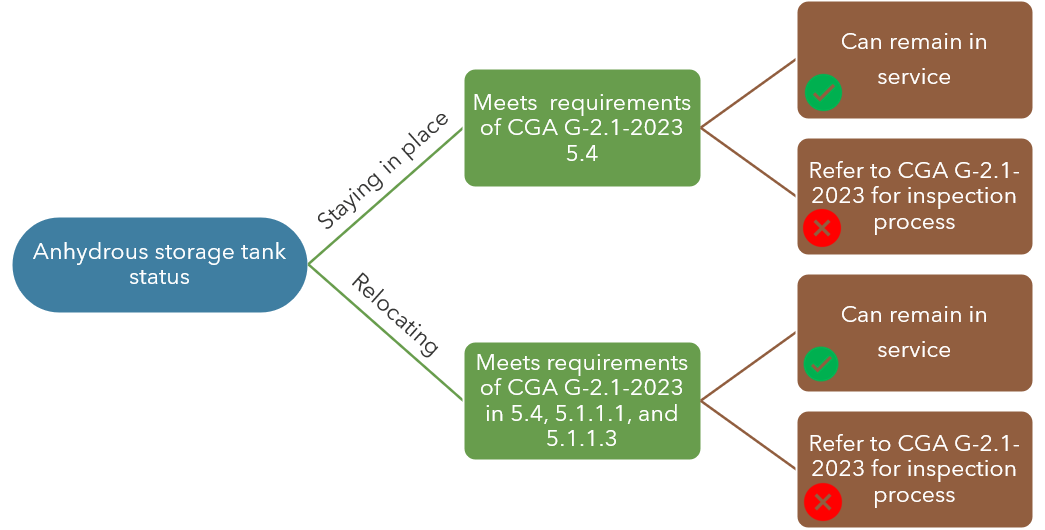
Relocating an existing storage vessel must also meet the data plate requirements and construction rules listed in the CGA. Facilities should refer to the decision tree below for guidance. If a facility determines the storage vessel does not meet relevant codes, the following tests are required:
- Testing for weld defects
- Wall thickness of the container shell and heads in inches or millimeters
Nothing in this document may be used to implement any enforcement action or levy any penalty unless promulgated by rule under chapter 536 or authorized by statute.
For more information
Air Pollution Control Program
Division of Environmental Quality
P.O. Box 176
Jefferson City, MO 65102-0176
United States